Appearance
从零实现一个简单 GNN:邻居之间怎样“传话”
这篇笔记用 PyTorch 手写一个非常小的 GNN/GCN,不依赖 PyTorch Geometric。
你会看到:
- 图数据和普通表格数据有什么不同。
- GNN 的核心:每个节点读取邻居的信息,再更新自己。
- 如何用矩阵乘法实现一次 message passing。
- 如何把它包装成
nn.Module并训练一个节点分类模型。
直观比喻:如果每个节点是一个人,边表示谁认识谁,GNN 就像让每个人先听朋友说几句话,再综合自己的信息做判断。
0. 环境准备
导入依赖:
python
import matplotlib.pyplot as plt
import torch
from torch import nn
import torch.nn.functional as F

torch.manual_seed(7)
print('torch version:', torch.__version__)
1. GNN 能做什么?
GNN 适合处理“对象之间有关系”的数据。常见任务包括:
- 节点分类:社交网络里判断用户兴趣、论文引用网络里判断论文主题。
- 边预测:推荐好友、预测商品和用户是否会交互。
- 整图分类:判断一个分子是否有毒、一个程序调用图是否危险。
今天我们做最小例子:节点分类。
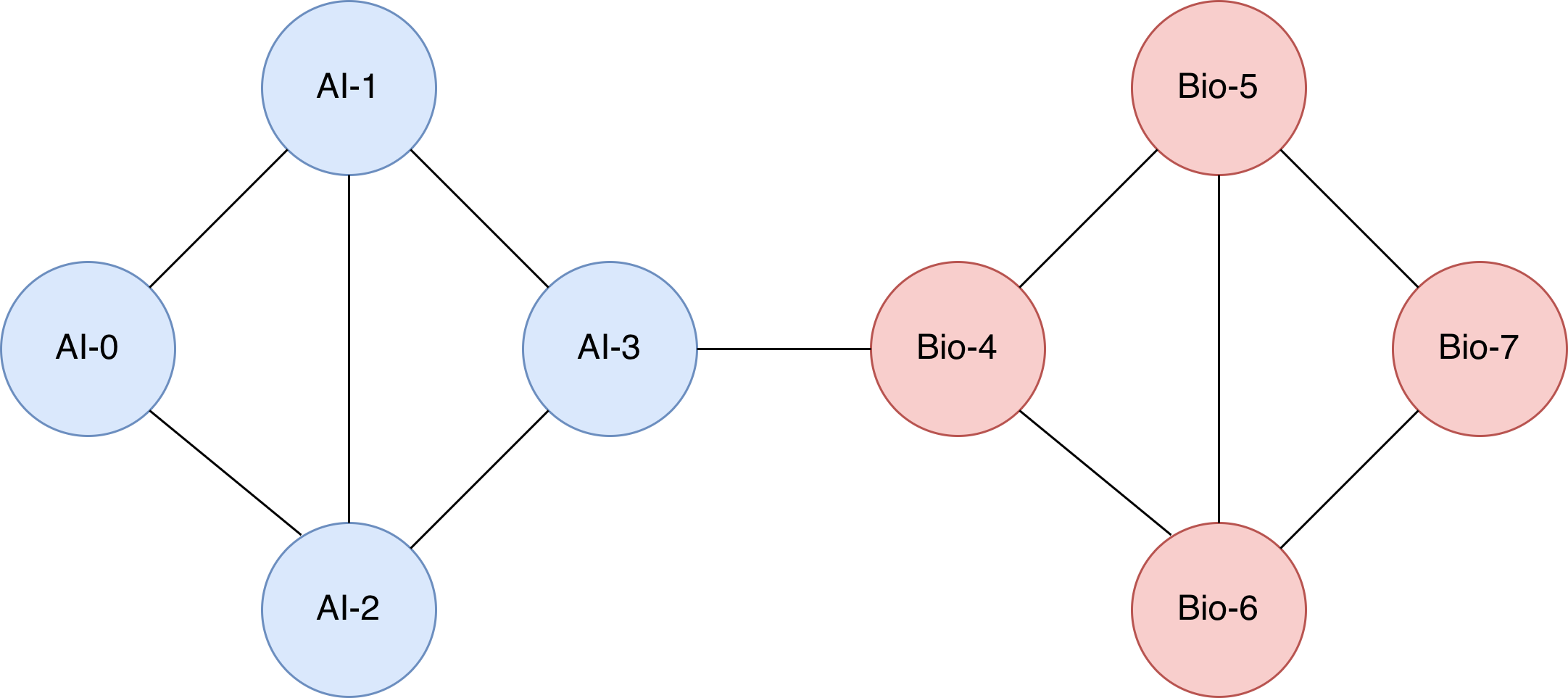
玩具设定:有 8 篇“论文”,它们互相引用。左边一团是 AI 论文,右边一团是生物论文。有些论文自己的关键词很模糊,但它们引用/被引用的邻居能帮我们判断主题。
python
node_names = [
    'AI-0', 'AI-1', 'AI-2?', 'AI-3?',
    'Bio-4', 'Bio-5', 'Bio-6?', 'Bio-7?',
]

# 标签:0 = AI, 1 = Biology
labels = torch.tensor([0, 0, 0, 0, 1, 1, 1, 1])

# 节点特征:前两个节点有清晰 AI 特征,中间几个是模糊特征。
# 这故意让纯 MLP 很难判断模糊节点,但 GNN 可以借助邻居。
features = torch.tensor([
    [1.0, 0.0, 0.0],  # clear AI
    [1.0, 0.0, 0.0],  # clear AI
    [0.0, 0.0, 1.0],  # ambiguous
    [0.0, 0.0, 1.0],  # ambiguous
    [0.0, 1.0, 0.0],  # clear Biology
    [0.0, 1.0, 0.0],  # clear Biology
    [0.0, 0.0, 1.0],  # ambiguous
    [0.0, 0.0, 1.0],  # ambiguous
])

# 无向边:两个主题各自内部连接紧密,节点 3 和 4 之间有一条弱桥。
edges = [
    (0, 1), (0, 2), (1, 2), (1, 3), (2, 3),
    (4, 5), (4, 6), (5, 6), (5, 7), (6, 7),
    (3, 4),
]

num_nodes = len(node_names)
adjacency = torch.zeros(num_nodes, num_nodes)
for i, j in edges:
    adjacency[i, j] = 1
    adjacency[j, i] = 1

print('features shape:', tuple(features.shape))
print('adjacency shape:', tuple(adjacency.shape))
adjacency
示例输出:
text
features shape: (8, 3)
adjacency shape: (8, 8)

tensor([[0., 1., 1., 0., 0., 0., 0., 0.],
        [1., 0., 1., 1., 0., 0., 0., 0.],
        [1., 1., 0., 1., 0., 0., 0., 0.],
        [0., 1., 1., 0., 1., 0., 0., 0.],
        [0., 0., 0., 1., 0., 1., 1., 0.],
        [0., 0., 0., 0., 1., 0., 1., 1.],
        [0., 0., 0., 0., 1., 1., 0., 1.],
        [0., 0., 0., 0., 0., 1., 1., 0.]])
邻接矩阵是一个 8 x 8 矩阵。第 i 行第 j 列为 1 表示节点 i 和节点 j 有边相连;为 0 表示没有直接连接。图结构如下图所示:
2. 一次 message passing 等于什么?
最朴素的想法:每个节点把邻居特征取平均。
但节点也应该保留自己的信息,所以先给图加 self-loop:每个节点连向自己。
公式上,一次邻居平均可以写成:
其中:
- 是邻接矩阵。
- 是 self-loop。
- 是度矩阵,用来做平均。
- 是节点特征。
python
adjacency_with_self = adjacency + torch.eye(num_nodes)
degree = adjacency_with_self.sum(dim=1, keepdim=True)
mean_aggregator = adjacency_with_self / degree

mixed_features = mean_aggregator @ features

print('原始特征 X:')
print(features)
print('\n经过一次邻居平均后的特征 D^-1(A+I)X:')
print(mixed_features.round(decimals=2))
示例输出:
text
原始特征 X:
tensor([[1., 0., 0.],
        [1., 0., 0.],
        [0., 0., 1.],
        [0., 0., 1.],
        [0., 1., 0.],
        [0., 1., 0.],
        [0., 0., 1.],
        [0., 0., 1.]])

经过一次邻居平均后的特征 D^-1(A+I)X:
tensor([[0.6700, 0.0000, 0.3300],
        [0.5000, 0.0000, 0.5000],
        [0.5000, 0.0000, 0.5000],
        [0.2500, 0.2500, 0.5000],
        [0.0000, 0.5000, 0.5000],
        [0.0000, 0.5000, 0.5000],
        [0.0000, 0.5000, 0.5000],
        [0.0000, 0.3300, 0.6700]])
观察上面的输出:模糊节点 [0, 0, 1] 在和 AI 邻居混合后,会带上 AI 分量;和 Biology 邻居混合后,会带上 Biology 分量。
这就是 GNN 的核心价值:节点不只看自己,还看自己处在什么关系网络里。
3. GCN 层:邻居聚合 + 可学习变换
真正的神经网络需要可学习参数。经典 GCN 的一层可写成:
为了训练更稳定,常用对称归一化:
python
def normalize_adjacency(adjacency_matrix):
    adjacency_with_self = adjacency_matrix + torch.eye(adjacency_matrix.size(0))
    degree = adjacency_with_self.sum(dim=1)
    degree_inv_sqrt = torch.pow(degree, -0.5)
    degree_inv_sqrt[torch.isinf(degree_inv_sqrt)] = 0.0
    d_inv_sqrt = torch.diag(degree_inv_sqrt)
    return d_inv_sqrt @ adjacency_with_self @ d_inv_sqrt

adjacency_norm = normalize_adjacency(adjacency)
adjacency_norm.round(decimals=2)
运行,输出对称归一化后的邻接矩阵如下:
tensor([[0.3300, 0.2900, 0.2900, 0.0000, 0.0000, 0.0000, 0.0000, 0.0000],
        [0.2900, 0.2500, 0.2500, 0.2500, 0.0000, 0.0000, 0.0000, 0.0000],
        [0.2900, 0.2500, 0.2500, 0.2500, 0.0000, 0.0000, 0.0000, 0.0000],
        [0.0000, 0.2500, 0.2500, 0.2500, 0.2500, 0.0000, 0.0000, 0.0000],
        [0.0000, 0.0000, 0.0000, 0.2500, 0.2500, 0.2500, 0.2500, 0.0000],
        [0.0000, 0.0000, 0.0000, 0.0000, 0.2500, 0.2500, 0.2500, 0.2900],
        [0.0000, 0.0000, 0.0000, 0.0000, 0.2500, 0.2500, 0.2500, 0.2900],
        [0.0000, 0.0000, 0.0000, 0.0000, 0.0000, 0.2900, 0.2900, 0.3300]])
定义图卷积层和图卷积神经网络模型如下:
python
class GraphConvolution(nn.Module):
    """A minimal GCN layer: output = A_norm @ Linear(node_features)."""

    def __init__(self, in_features, out_features):
        super().__init__()
        self.linear = nn.Linear(in_features, out_features, bias=False)

    def forward(self, node_features, adjacency_norm):
        transformed = self.linear(node_features)
        return adjacency_norm @ transformed


class TinyGCN(nn.Module):
    def __init__(self, in_features, hidden_features, num_classes):
        super().__init__()
        self.gcn1 = GraphConvolution(in_features, hidden_features)
        self.gcn2 = GraphConvolution(hidden_features, num_classes)

    def forward(self, node_features, adjacency_norm):
        hidden = self.gcn1(node_features, adjacency_norm)
        hidden = F.relu(hidden)
        logits = self.gcn2(hidden, adjacency_norm)
        return logits


model = TinyGCN(in_features=3, hidden_features=8, num_classes=2)
print(model)
这里有两个关键点:
Linear负责学习如何变换节点特征。adjacency_norm @ transformed负责把邻居信息传播过来。
4. 训练:只给少数节点标签
我们只把 0、1、4、5 这四个“特征清晰”的节点作为训练集。
模型要把图结构中的信息传播到 2、3、6、7 这些模糊节点上。
python
train_mask = torch.tensor([True, True, False, False, True, True, False, False])
test_mask = ~train_mask

optimizer = torch.optim.Adam(model.parameters(), lr=0.05, weight_decay=1e-3)

history = []
for epoch in range(25):
    model.train()
    optimizer.zero_grad()

    logits = model(features, adjacency_norm)
    loss = F.cross_entropy(logits[train_mask], labels[train_mask])

    loss.backward()
    optimizer.step()

    with torch.no_grad():
        prediction = logits.argmax(dim=1)
        train_acc = (prediction[train_mask] == labels[train_mask]).float().mean().item()
        test_acc = (prediction[test_mask] == labels[test_mask]).float().mean().item()
        history.append((loss.item(), train_acc, test_acc))

    if (epoch+1) % 5 == 0:
        print(f'epoch={epoch+!:03d} loss={loss.item():.4f} train_acc={train_acc:.2f} test_acc={test_acc:.2f}')
示例输出:
text
epoch=005 loss=0.5736 train_acc=0.75 test_acc=0.50
epoch=010 loss=0.3862 train_acc=1.00 test_acc=0.75
epoch=015 loss=0.1861 train_acc=1.00 test_acc=0.75
epoch=020 loss=0.0558 train_acc=1.00 test_acc=1.00
epoch=025 loss=0.0124 train_acc=1.00 test_acc=1.00
绘制训练曲线:
python
losses, train_accs, test_accs = zip(*history)
plt.figure(figsize=(8, 3))
plt.subplot(1, 2, 1)
plt.plot(losses)
plt.title('Training loss')
plt.xlabel('epoch')

plt.subplot(1, 2, 2)
plt.plot(train_accs, label='train')
plt.plot(test_accs, label='test')
plt.ylim(-0.05, 1.05)
plt.title('Accuracy')
plt.xlabel('epoch')
plt.legend()
plt.tight_layout()
plt.show()
查看每个节点的预测结果:
python
model.eval()
with torch.no_grad():
    logits = model(features, adjacency_norm)
    probabilities = logits.softmax(dim=1)
    predictions = logits.argmax(dim=1)

for i, name in enumerate(node_names):
    true_label = 'AI' if labels[i].item() == 0 else 'Bio'
    pred_label = 'AI' if predictions[i].item() == 0 else 'Bio'
    split = 'train' if train_mask[i] else 'test '
    confidence = probabilities[i, predictions[i]].item()
    print(f'{name:6s} [{split}] true={true_label:3s} pred={pred_label:3s} confidence={confidence:.2f}')
示例输出:
text
AI-0   [train] true=AI  pred=AI  confidence=0.99
AI-1   [train] true=AI  pred=AI  confidence=0.98
AI-2?  [test ] true=AI  pred=AI  confidence=0.98
AI-3?  [test ] true=AI  pred=AI  confidence=0.77
Bio-4  [train] true=Bio pred=Bio confidence=0.99
Bio-5  [train] true=Bio pred=Bio confidence=1.00
Bio-6? [test ] true=Bio pred=Bio confidence=1.00
Bio-7? [test ] true=Bio pred=Bio confidence=0.99
5. 小结
GNN 的基本套路可以压缩成三句话:
- 每个节点有自己的特征,图告诉我们节点之间有什么关系。
- 一层 GNN 让节点聚合邻居信息,再用可学习参数变换。
- 多层 GNN 就是在更大范围内传递信息:一层看一跳邻居,两层看两跳邻居。
这个例子只实现了最小 GCN。真实项目会继续考虑大图采样、稀疏矩阵、边特征、动态图、过平滑、归纳泛化等问题。